Scalp Cooling and Medicare: The 2026 Coverage Change
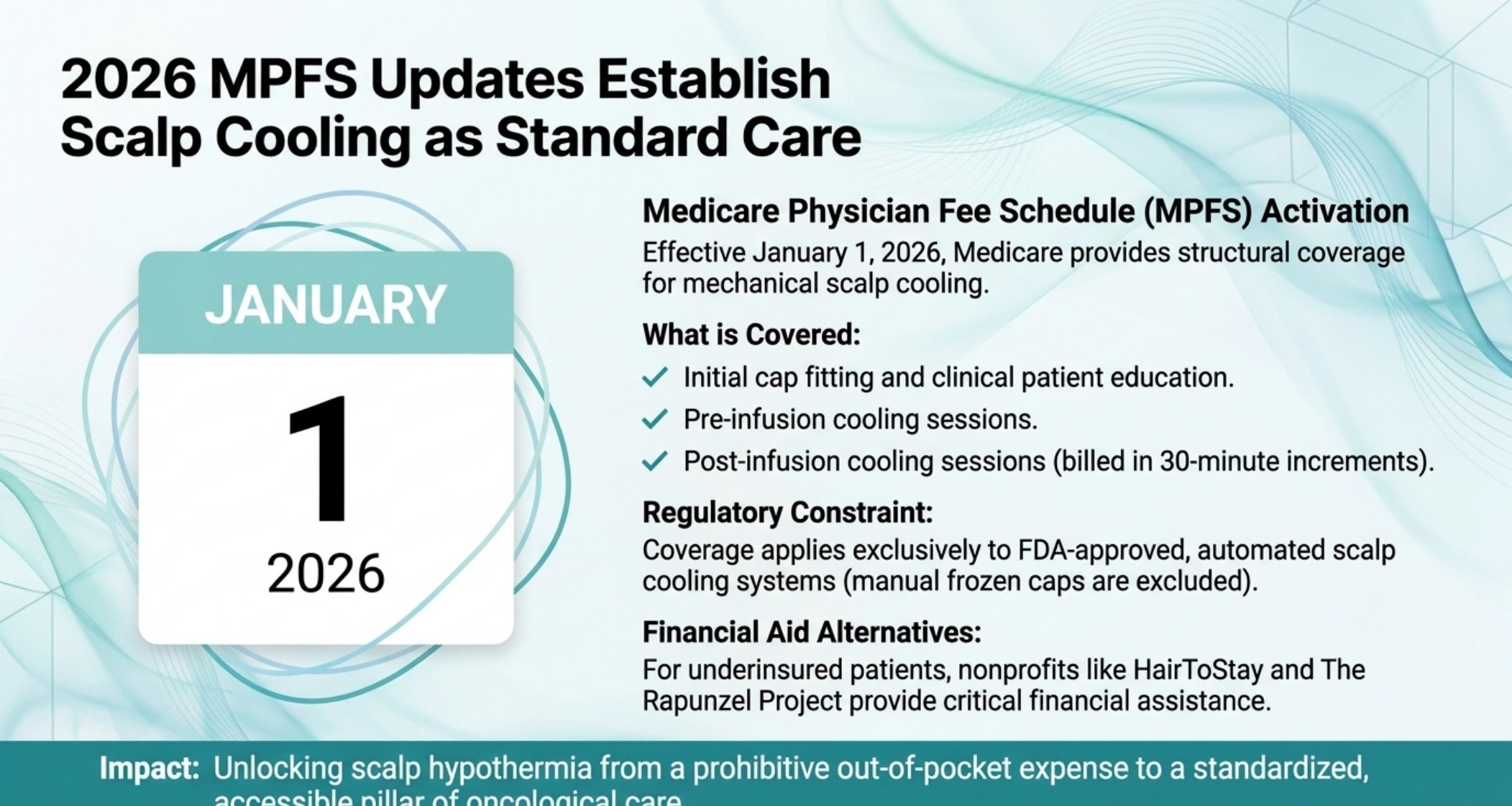
Effective January 1, 2026, the Medicare Physician Fee Schedule (MPFS) activates structural coverage for mechanical scalp cooling, and that single change reframes the decision for patients who previously met it as a purely out-of-pocket expense. The coverage is real but conditional. Medicare covers the initial cap fitting and clinical patient education, pre-infusion cooling sessions, and post-infusion cooling sessions billed in 30-minute increments. The constraint is the technology: coverage applies exclusively to FDA-approved, automated scalp cooling systems, which excludes manual frozen caps. For patients who still fall outside that net — underinsured, or treated on a manual system — nonprofits such as HairToStay and The Rapunzel Project provide financial assistance. The net effect is a shift from a prohibitive out-of-pocket burden to a standardized, accessible pillar of oncological care.
What Actually Changed on January 1, 2026
Before this change, scalp cooling sat outside structured reimbursement, which meant the cost landed on the patient regardless of clinical need. The MPFS activation on January 1, 2026 converts it into a covered service with defined components. Three things are now recognized: initial cap fitting and clinical patient education, pre-infusion cooling sessions, and post-infusion cooling sessions.
The design of that coverage list tracks the clinical workflow rather than an arbitrary schedule. Cooling runs as a three-phase protocol — pre-infusion, active infusion and post-infusion — and Medicare coverage maps onto the phases that involve clinical time and oversight. For a patient in Huntsville, that means the coverage question is no longer whether cooling is a covered category but whether the specific device in the room qualifies.
| Item | Status | Note |
|---|---|---|
| Coverage activation | Effective January 1, 2026 | Medicare MPFS provides structural coverage for mechanical scalp cooling |
| Initial cap fitting and clinical patient education | Covered | Recognized as a distinct clinical step |
| Pre-infusion cooling sessions | Covered | Scalp brought to target temperature before drugs enter the system |
| Post-infusion cooling sessions | Covered | Billed in 30-minute increments |
| Manual frozen caps | Excluded | Coverage applies only to FDA-approved, automated systems |
Reading the 30-Minute Increments
Post-infusion cooling is billed in 30-minute increments, and that billing unit is not cosmetic. Post-infusion cooling exists because the scalp must stay cold after the IV is removed so the drugs fully clear the localized vascular system. The duration is set by the regimen, not by a fixed appointment block, so a unit-based structure is what lets the coverage scale with the clinical need rather than underpay a longer case or overpay a short one.
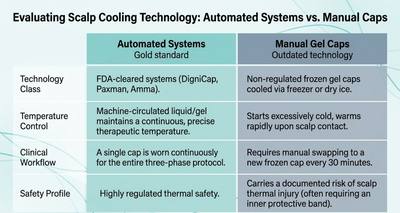
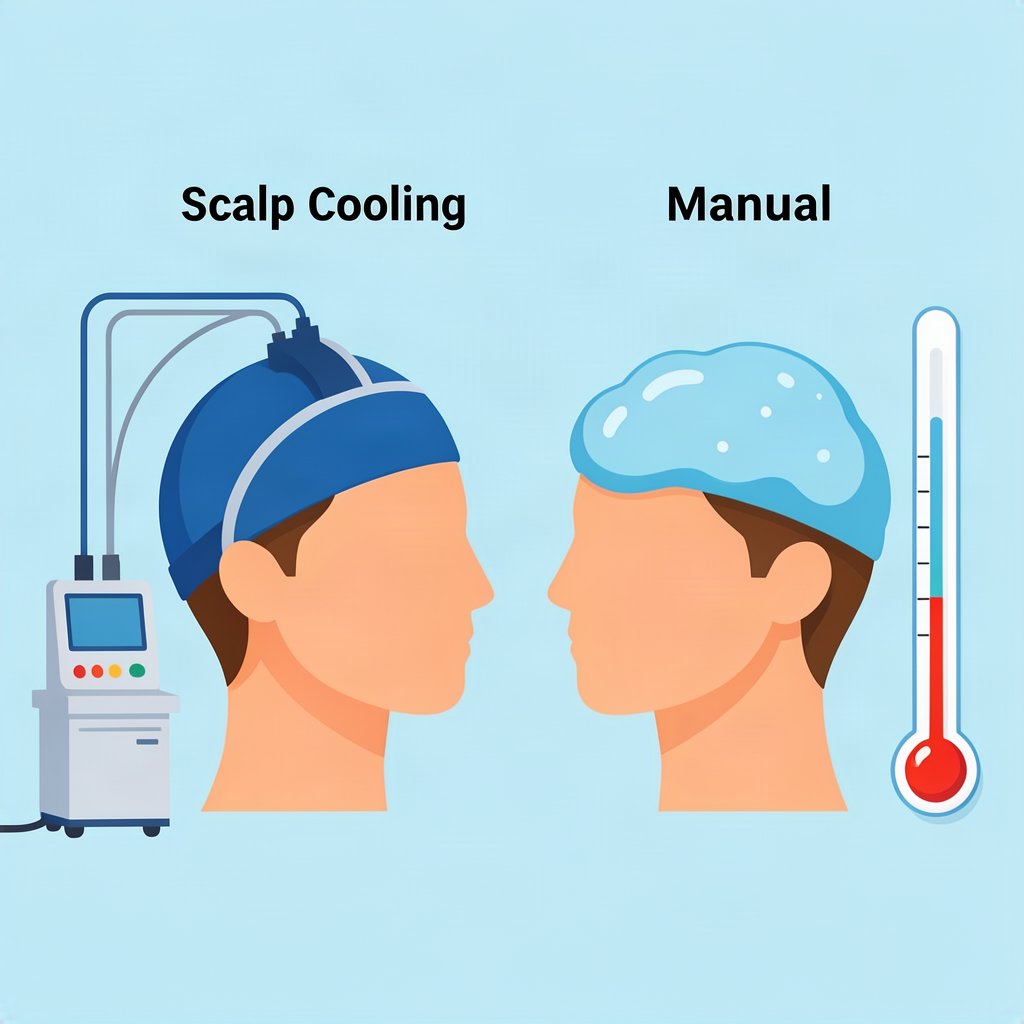
The same 30-minute figure appears on the other side of the comparison, and the symmetry is worth noting. A manual gel cap requires swapping to a new frozen cap every 30 minutes, and each swap means a fresh billing period but also a break in continuous cooling. Automated systems hold one cap continuously for the entire three-phase protocol, so the clinical time and the billing unit line up with the protection actually delivered.
| System | Coverage status | Handling difference |
|---|---|---|
| FDA-approved automated systems (DigniCap, Paxman, Amma) | Covered | One cap worn continuously for the full three-phase protocol |
| Manual non-regulated frozen gel caps | Excluded | New frozen cap every 30 minutes; documented risk of scalp thermal injury |
The Automated-System Constraint
The coverage rule is narrow on purpose: only FDA-approved, automated systems qualify. That mirrors the clinical standard rather than creating a new one. Automated devices circulate machine-cooled liquid or gel to maintain a continuous, precise therapeutic temperature, and they sit in an FDA-cleared class with regulated thermal safety.
Manual frozen caps occupy the opposite position. They are non-regulated, cooled in a freezer or on dry ice, start excessively cold and warm rapidly on scalp contact, and carry a documented risk of scalp thermal injury that often requires an inner protective band. Coverage and clinical best practice therefore point the same direction: the technology that holds a stable therapeutic temperature is the technology the 2026 schedule pays for.
When Coverage Still Is Not Enough
Coverage is not the same as zero cost, and two groups remain exposed: patients who are underinsured and patients treated at centers still running manual systems. For those cases, nonprofit assistance is the documented fallback. HairToStay and The Rapunzel Project both provide financial assistance for scalp cooling, and both are named specifically in the 2026 coverage framework as alternatives for underinsured patients.
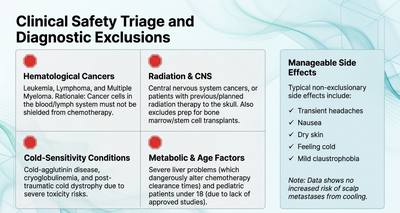
The gap is easiest to see in the manual-cap scenario, where the same 30 minutes that defines a billing increment also defines a cap swap. A patient on a manual system pays for the session without the coverage, and the clinical downside compounds: repeated re-fitting can create warm zones that produce patchy hair loss. Asking whether nonprofit support applies before the first cycle is therefore a financial question and a clinical one at the same time.
| Source | Role |
|---|---|
| HairToStay | Nonprofit financial assistance for scalp cooling |
| The Rapunzel Project | Nonprofit financial assistance for scalp cooling |
How Huntsville Patients Should Prepare
For a patient in Huntsville, the practical sequence is short. Confirm which device the treatment center runs, because the answer decides whether the 2026 coverage applies at all. Ask how the initial fitting and patient education, the pre-infusion session and each 30-minute post-infusion increment will be documented, since those are the covered components. If the center runs manual caps, ask about nonprofit assistance rather than assuming the expense is unavoidable, and if coverage still leaves a gap, get a second opinion on device availability in Alabama before committing to a protocol that the schedule will not pay for. This article is educational information, not medical advice, and a qualified provider should assess the individual case.
Frequently Asked Questions
Does Medicare cover scalp cooling in 2026?
Yes, for qualifying systems. Effective January 1, 2026, the Medicare Physician Fee Schedule provides structural coverage for mechanical scalp cooling, including initial cap fitting and clinical patient education, pre-infusion cooling sessions, and post-infusion cooling sessions billed in 30-minute increments.
Do manual frozen cold caps qualify for coverage?
No. Coverage applies exclusively to FDA-approved, automated scalp cooling systems such as DigniCap, Paxman and Amma. Manual non-regulated frozen gel caps cooled via freezer or dry ice are excluded, even though they require a new cap every 30 minutes.
What if I am underinsured and still cannot afford cooling?
Nonprofit financial assistance is the documented alternative. HairToStay and The Rapunzel Project both provide financial assistance for scalp cooling for underinsured patients. You can also review the cost guide, check the scalp cooling guide, or ask a local provider directly.
Get matched with hair restoration professionals →
Ready for a Professional Review?
We can connect you with qualified hair restoration professionals who can map your situation to the right treatment.
Get Matched with Hair Restoration Professionals