Automated vs Manual Cold Caps: Which Actually Works
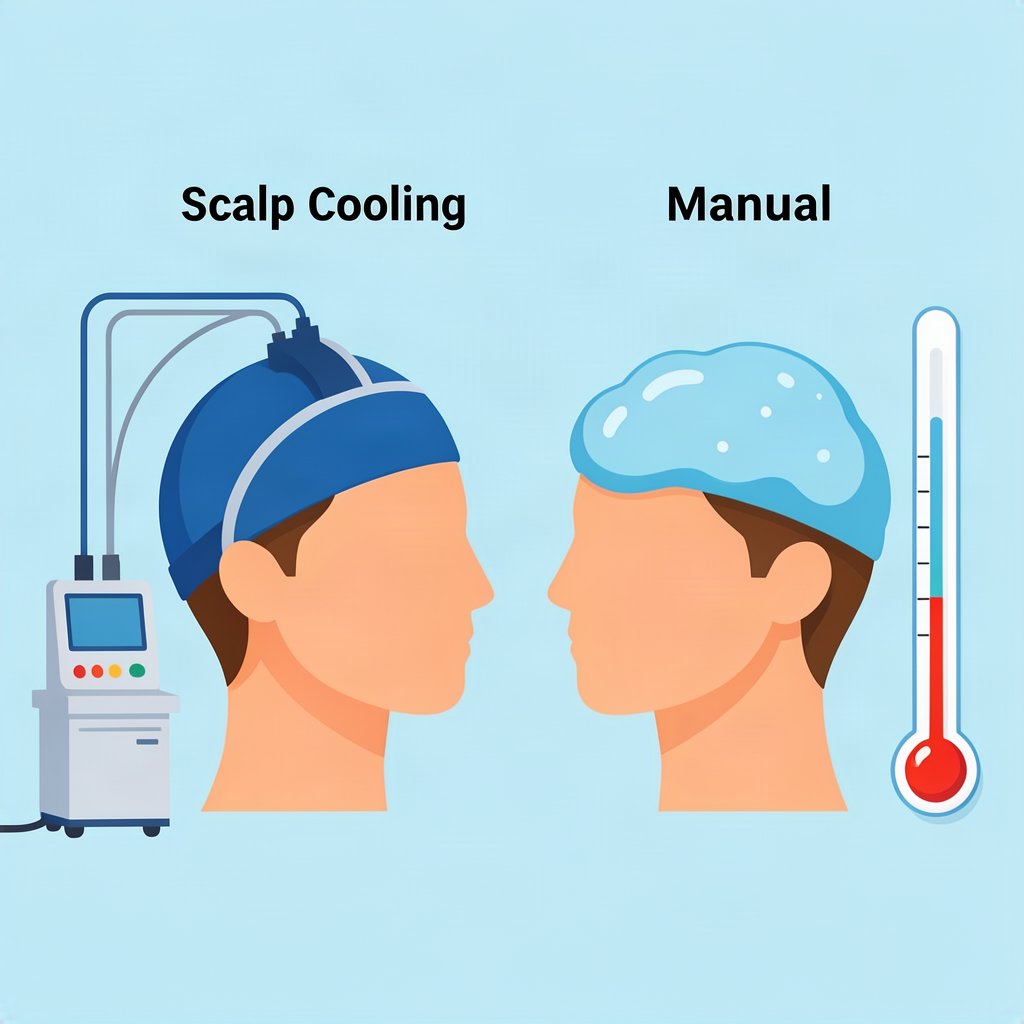
If chemotherapy is on your calendar and keeping your hair matters, the decision that shapes the outcome is made before your first infusion: which cooling technology your treatment center runs. The clinical verdict is not close. FDA-cleared automated systems — DigniCap, Paxman and Amma — are the gold standard. Manual frozen gel caps are classified as outdated technology. The separation is measurable, and it comes down to three variables: how precisely scalp temperature is held, how often the cap must be changed, and whether the device operates under regulated thermal-safety limits. An automated system circulates machine-cooled liquid or gel to maintain a continuous, precise therapeutic temperature throughout the protocol. A manual cap is a non-regulated frozen gel pack, chilled in a freezer or on dry ice, that starts excessively cold and warms rapidly the moment it contacts the scalp.
Regulated Devices vs Frozen Gel Packs: The Technology Divide
The two devices belong to different regulatory classes, and that is the first question to put to any clinic. Automated systems sit in an FDA-cleared class: their cooling output and temperature behaviour are documented and constrained. Manual gel caps are non-regulated, their starting temperature a function of freezer settings or how long the pack sat on dry ice rather than a calibrated set point. For anyone in Huntsville comparing cooling before a first cycle, that one distinction determines everything downstream.
Temperature control is where the mechanism lives. Scalp hypothermia constricts localized blood vessels, creating a physical barrier that reduces the volume of chemotherapy agents reaching the hair follicle cells and prevents cellular damage. That barrier exists only while the scalp is genuinely cold. A machine-circulated cap maintains a continuous, precise therapeutic temperature; a manual cap starts excessively cold and warms rapidly upon scalp contact, so the most protective minutes are the first few after application, and protection decays from there.
| Variable | Automated systems | Manual gel caps |
|---|---|---|
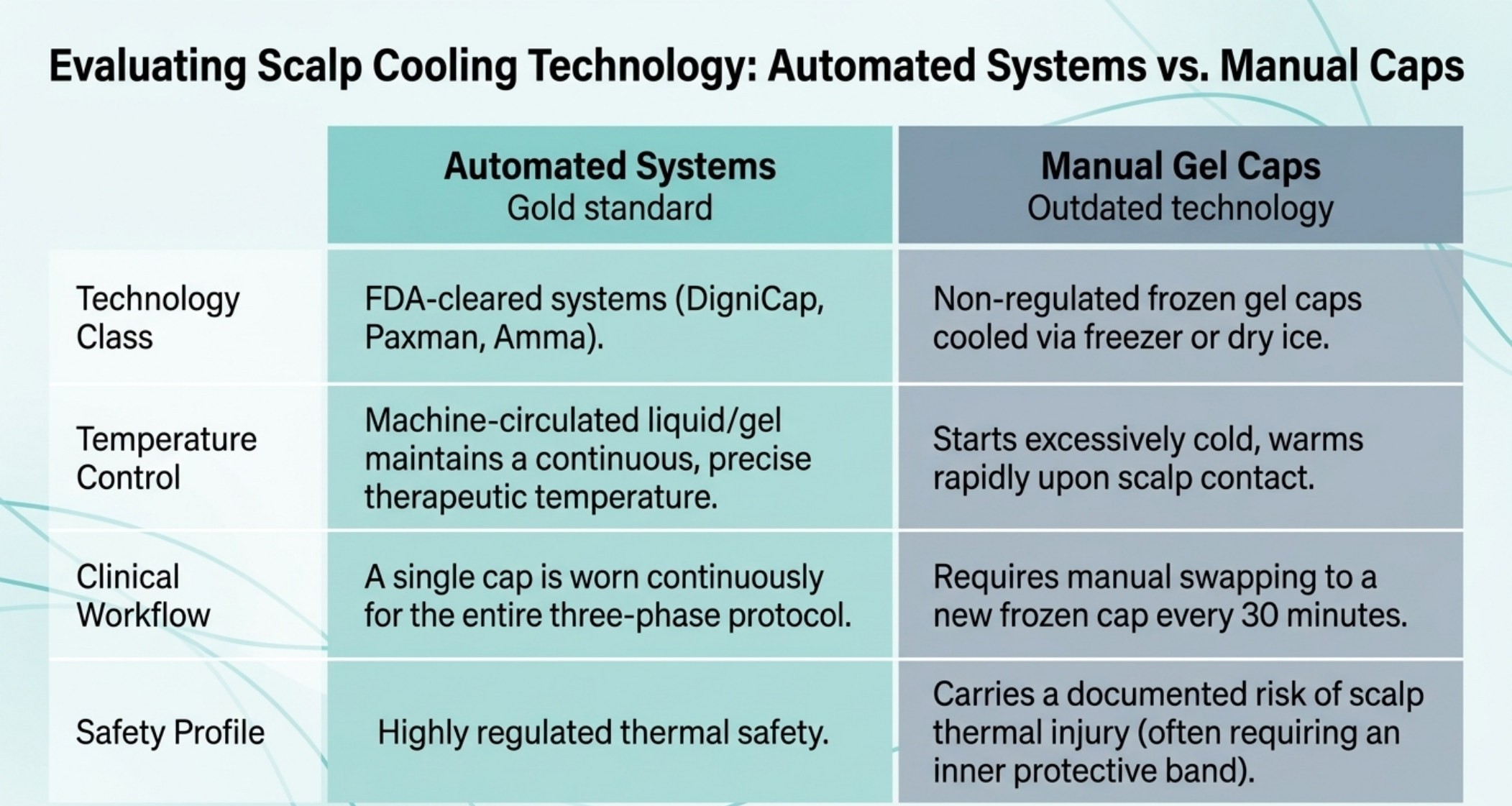
| Technology class | Gold standard; FDA-cleared systems (DigniCap, Paxman, Amma) | Outdated technology; non-regulated frozen gel caps cooled via freezer or dry ice |
| Temperature control | Machine-circulated liquid/gel maintains a continuous, precise therapeutic temperature | Starts excessively cold, warms rapidly upon scalp contact |
| Clinical workflow | A single cap is worn continuously for the entire three-phase protocol | Requires manual swapping to a new frozen cap every 30 minutes |
| Safety profile | Highly regulated thermal safety | Documented risk of scalp thermal injury, often requiring an inner protective band |
The 30-Minute Swap and the Three-Phase Protocol
Manual cooling carries a workflow number that automated systems do not: the cap must be swapped for a fresh frozen one every 30 minutes. Over a multi-hour infusion that means repeated lifting, breaking the cold seal and re-seating the cap, and every removal interrupts the thermal hold the follicle cells depend on.
Automated cooling removes the interruption. A single cap stays on continuously for the entire three-phase protocol. Phase 1, pre-infusion: the scalp is brought down to the target therapeutic temperature before the chemotherapy agents enter the system. Phase 2, active infusion: continuous, regulated hypothermia is maintained for the duration of administration. Phase 3, post-infusion: cooling continues after the IV is removed so the drugs fully clear the localized vascular system.
| Protocol phase | Automated handling | Manual handling |
|---|---|---|
| Phase 1 — Pre-infusion | Same cap pre-cooled to target temperature | New frozen cap applied |
| Phase 2 — Active infusion | Continuous thermoregulation, no cap change | Swap to a new frozen cap every 30 minutes |
| Phase 3 — Post-infusion | Cooling held until drugs clear the vascular system | Continued 30-minute swap cycle until protocol ends |
Cap Fit Is the Efficacy Variable Nobody Prices In
A tight, uniform fit is mandatory for either class. Poor contact between cap and scalp creates warm zones, and warm zones reliably produce patchy hair loss — the failure pattern is predictable, not random. A continuous automated cap holds uniform contact by design; a cap that is removed, re-frozen and re-seated every 30 minutes has repeated windows in which fit can drift.
Hair itself changes the calculus. Thicker hair layers naturally insulate the scalp, which can mildly reduce cooling efficacy. That is a fitting problem to be engineered around, not a reason to abandon cooling, but it means the fitting step deserves the same rigor as any other clinical decision in Alabama treatment planning.
Thermal Safety: What the Protective Band Tells You
The safety profiles diverge in a way that is easy to read on the device itself. Automated systems operate under highly regulated thermal safety. Manual caps carry a documented risk of scalp thermal injury, often requiring an inner protective band — the band is an admission that unregulated cold can damage tissue when it starts excessively cold.
One boundary applies to both classes and is worth stating plainly: scalp cooling is effective against standard chemotherapy agents, but it does not prevent hair loss caused by immunotherapy or targeted drug therapies. Success rates also vary by chemotherapy dose and type, so a cooling plan is an individual clinical judgement rather than a guaranteed outcome.
| Checkpoint | What to confirm |
|---|---|
| Device class | Is it an FDA-cleared automated system (DigniCap, Paxman, Amma) or a non-regulated gel cap? |
| Thermal safety | Regulated thermal ceiling, and whether an inner protective band is required |
| Swap cadence | Continuous wear vs a new frozen cap every 30 minutes |
| Treatment scope | Standard chemotherapy only — not immunotherapy or targeted drug therapies |
What This Means for Huntsville Patients
In Huntsville, the practical move is to ask a treatment center which class of device it runs before the first infusion, because switching mid-protocol is not simple. If the answer is a manual cap, the follow-up questions are the swap cadence, the re-fit procedure between swaps, and whether an inner protective band is used. If the answer is an automated system, the questions are fit and temperature continuity across all three phases. Either way, the evidence favours continuous, precisely regulated cooling over freezer-dependent hardware. This article is educational information, not medical advice, and a qualified provider should assess the individual case.
Frequently Asked Questions
Are automated cold caps actually better than manual gel caps?
Yes, by the standards laid out here. Automated systems are FDA-cleared devices (DigniCap, Paxman, Amma) that maintain a continuous, precise therapeutic temperature and are worn as a single cap for the entire three-phase protocol. Manual gel caps are non-regulated, start excessively cold, warm rapidly on contact, and require a fresh frozen cap every 30 minutes.
Why does the 30-minute swap matter so much?
Because the scalp must stay cold while the chemotherapy drugs are circulating. Every manual swap breaks contact and re-seats the cap, and poor contact creates warm zones that reliably produce patchy hair loss. Continuous cooling avoids that interruption entirely.
Does scalp cooling work for every chemotherapy regimen?
No. It is effective against standard chemotherapy agents but does not prevent hair loss from immunotherapy or targeted drug therapies, and success rates vary by dose and type. Thicker hair layers can also mildly reduce cooling efficacy, which is why fit is treated as a clinical variable. You can review the underlying workflow on our scalp cooling guide, compare device classes in our comparison hub, or use the decision tools to structure your questions.
Get matched with hair restoration professionals →
Ready for a Professional Review?
We can connect you with qualified hair restoration professionals who can map your situation to the right treatment.
Get Matched with Hair Restoration Professionals