Scalp Cooling Safety Triage and Diagnostic Exclusions
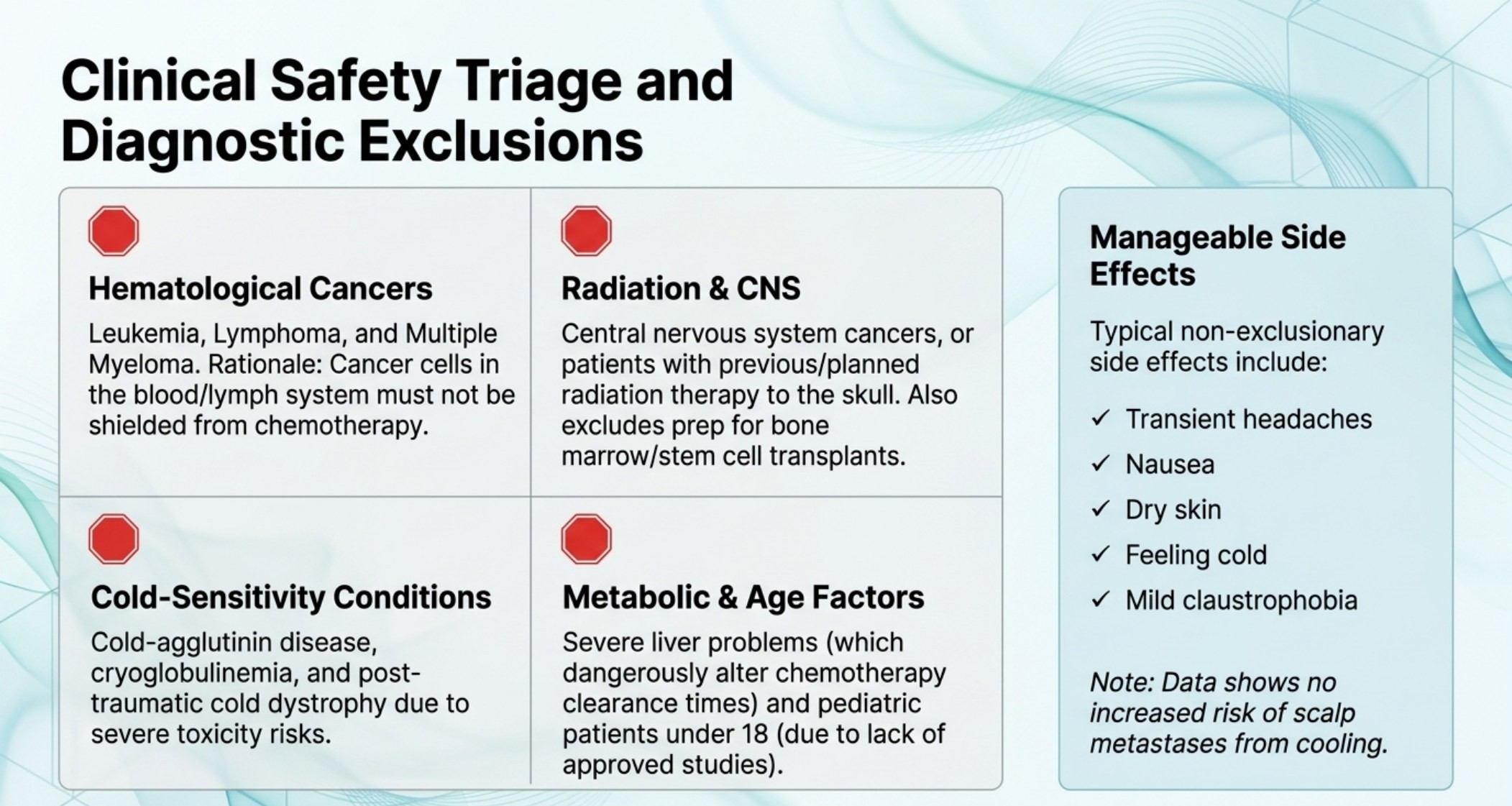
Scalp cooling is not offered to every patient who asks for it, and the reasons are clinical rather than administrative. Before a first cap is fitted, a triage step separates the patients who can be cooled from those who cannot. Hematological cancers — Leukemia, Lymphoma and Multiple Myeloma — are excluded because cancer cells circulating in the blood or lymph system must not be shielded from chemotherapy. Central nervous system cancers, or any previous or planned radiation therapy to the skull, are excluded, as is preparation for bone marrow or stem cell transplants. Cold-sensitivity conditions — cold-agglutinin disease, cryoglobulinemia and post-traumatic cold dystrophy — are excluded because of severe toxicity risks. Severe liver problems are excluded because they dangerously alter chemotherapy clearance times, and pediatric patients under 18 are excluded for lack of approved studies. The side effects most people actually experience, by contrast, do not disqualify anyone.
Why Blood Cancers Sit Outside the Protocol
The hematological exclusion is the one patients question most, because it looks counterintuitive: cooling protects tissue, so why would it be withheld from a blood cancer? The rationale is the mechanism itself. Scalp hypothermia constricts localized blood vessels so less chemotherapy reaches the hair follicle cells. In Leukemia, Lymphoma and Multiple Myeloma, the cancer cells are in the blood and lymph system, and the same constriction that protects a follicle could shield circulating cancer cells from the drug that is meant to reach them. The exclusion is a deliberate trade: no cooling, full drug exposure.
That logic does not extend to solid tumors, which is why cooling protocols are optimized for solid tumor patients while excluding hematological cancers. A patient in Huntsville being triaged should expect the cancer type question to come first, before fit, before scheduling, before anything else.
| Exclusion category | Conditions included | Clinical rationale |
|---|---|---|
| Hematological cancers | Leukemia, Lymphoma, Multiple Myeloma | Cancer cells in the blood/lymph system must not be shielded from chemotherapy |
| Radiation & CNS | Central nervous system cancers; previous or planned radiation therapy to the skull; prep for bone marrow/stem cell transplants | Direct conflict with the treatment target or the transplant protocol |
| Cold sensitivity | Cold-agglutinin disease, cryoglobulinemia, post-traumatic cold dystrophy | Severe toxicity risks under controlled cooling |
| Metabolic & age | Severe liver problems; pediatric patients under 18 | Liver disease dangerously alters chemotherapy clearance times; under-18 patients lack approved studies |
CNS Cancer, Skull Radiation and Transplant Prep
The second exclusion cluster concerns the scalp as a treatment field or a recovery site. Central nervous system cancers are excluded, and so are patients with previous or planned radiation therapy to the skull — cooling a scalp that is itself a radiation target adds no protection and complicates the plan. Preparation for bone marrow or stem cell transplants is also excluded.
Read together, these three groups cover situations where the scalp is either being actively treated or about to be involved in a systemic reset of the blood and immune system. In both cases, the vasoconstriction that makes cooling useful is the wrong tool, and the triage decision is a straightforward exclusion rather than a judgement call.
The transplant exclusion carries its own logic: bone marrow or stem cell transplant preparation involves conditioning regimens that reset the blood and immune system, and scalp cooling is not part of that pathway. In practice the triage question is simple — is the scalp a radiation target, a CNS treatment site, or part of a transplant protocol? If the answer to any of those is yes, cooling is set aside and treatment proceeds without it. For solid tumor patients the same triage clears the way, which is why the exclusion list is short and specific rather than open-ended.
Cold-Sensitivity Conditions and Metabolic Limits
Cold-agglutinin disease, cryoglobulinemia and post-traumatic cold dystrophy are absolute exclusions because of severe toxicity risks — these are conditions in which cold itself is the hazard, so a protocol built on sustained scalp hypothermia is the wrong fit regardless of how well the cap is fitted.
Two further thresholds are metabolic and age-based. Severe liver problems are excluded because they dangerously alter chemotherapy clearance times, which changes both drug exposure and the safety margin. Pediatric patients under 18 are excluded because approved studies are lacking, so there is no evidence base to dose or monitor cooling safely in that group. Neither exclusion is softened by the routine success of cooling in adults.
| Threshold | Status | Reason |
|---|---|---|
| Cold-agglutinin disease | Excluded | Severe toxicity risk from cold exposure |
| Cryoglobulinemia | Excluded | Severe toxicity risk from cold exposure |
| Post-traumatic cold dystrophy | Excluded | Severe toxicity risk from cold exposure |
| Severe liver problems | Excluded | Dangerously alters chemotherapy clearance times |
| Pediatric patients under 18 | Excluded | Lack of approved studies |
Side Effects That Do Not Disqualify You
The side-effect list that patients fear is short, and every item on it is non-exclusionary. Transient headaches, nausea, dry skin, feeling cold and mild claustrophobia are the typical effects, and none of them removes a patient from the protocol. The distinction matters because the two lists are commonly conflated in conversation.
One safety question is settled by the data: cooling does not increase the risk of scalp metastases. The mechanism — constricted vessels reducing drug delivery to follicle cells — does not open a path for cancer to seed the scalp, which is the concern patients most often raise before consenting.
| Reported side effect | Triage status |
|---|---|
| Transient headaches | Non-exclusionary |
| Nausea | Non-exclusionary |
| Dry skin | Non-exclusionary |
| Feeling cold | Non-exclusionary |
| Mild claustrophobia | Non-exclusionary |
| Risk of scalp metastases | Data shows no increased risk from cooling |
How Triage Plays Out in Huntsville
In Huntsville and across Alabama, triage before scalp cooling is a checklist conversation, not a long work-up. Cancer type first, then radiation history and transplant status, then cold-sensitivity conditions, then liver function and age. A patient who clears all five thresholds still needs a tight, uniform cap fit, because poor contact creates warm zones that reliably produce patchy hair loss — the most common avoidable failure in the protocol. This article is educational information, not medical advice, and a qualified provider should assess the individual case.
Frequently Asked Questions
Why can't patients with Leukemia or Lymphoma use cold caps?
Because the cancer cells are in the blood and lymph system, and the vasoconstriction that cooling creates could shield them from the chemotherapy meant to reach them. Protocols are optimized for solid tumor patients and exclude hematological cancers for exactly that reason.
Which cold-related conditions rule out scalp cooling?
Cold-agglutinin disease, cryoglobulinemia and post-traumatic cold dystrophy are all excluded because of severe toxicity risks. Severe liver problems and pediatric patients under 18 are excluded on separate grounds — altered chemotherapy clearance times and a lack of approved studies, respectively.
Do headaches or nausea mean I should stop cooling?
No. Transient headaches, nausea, dry skin, feeling cold and mild claustrophobia are the typical side effects and are all non-exclusionary, and the data shows no increased risk of scalp metastases from cooling. Compare this with the device-level differences in the scalp cooling guide, check our FAQ, or read how the matching process works.
Get matched with hair restoration professionals →
Ready for a Professional Review?
We can connect you with qualified hair restoration professionals who can map your situation to the right treatment.
Get Matched with Hair Restoration Professionals